For generations, bakers have relied on yeast to transform flour, water, and other ingredients into the breads people love. Today, two forms remain especially common: Instant Dry Yeast (IDY) and Fresh Yeast, also known as compressed yeast.
At first glance, the two products may seem interchangeable. Both contain living yeast cells and perform the same fundamental job: fermenting sugars and producing carbon dioxide that gives dough its volume.
But for a baker, choosing between them involves much more than simply asking which one makes dough rise. The real differences appear in usage level, storage, shelf life, handling, transportation, consistency, cost- in-use, and convenience.
Two Forms of the Same Essential Ingredient
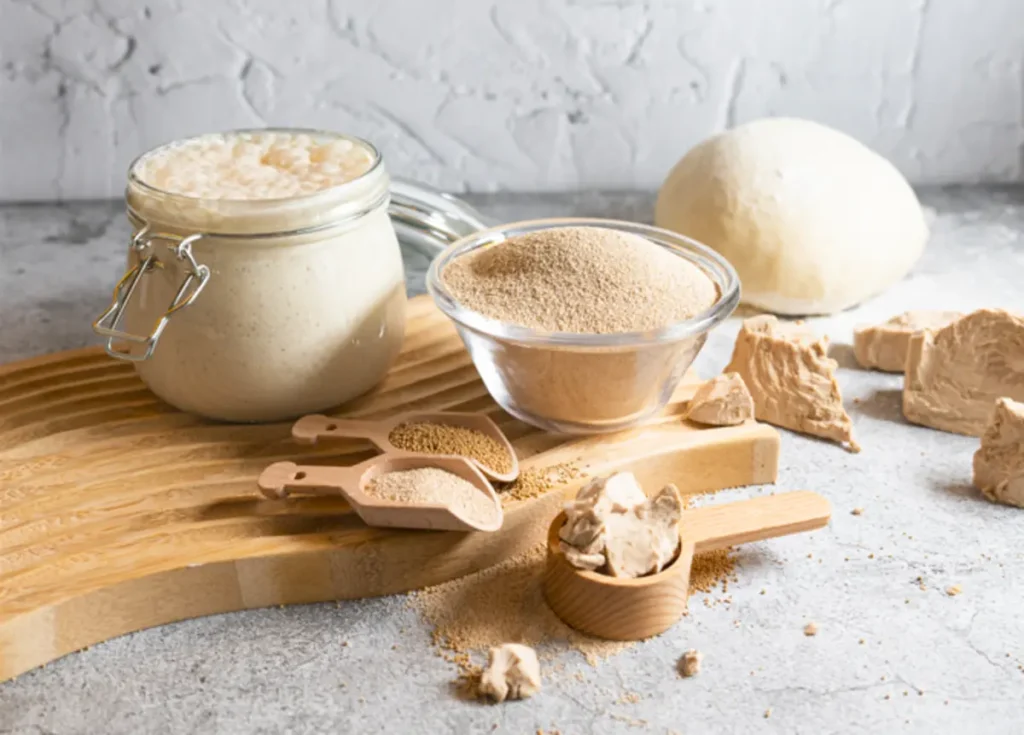
Fresh yeast contains a high amount of water (approximately 70%) and is sold as a soft, moist, compressed block. Because of its high moisture content, it is highly perishable and must be kept refrigerated.
Instant Dry Yeast, on the other hand, has most of its moisture removed (approximately 5% remained). This difference in moisture is important because it also explains why a baker cannot simply replace fresh yeast with the same weight of IDY.
A typical starting conversion is approximately:
1 part IDY ≈ 3 parts fresh yeast by weight.
For example, if a formula uses 30 g of fresh yeast, approximately 10 g of IDY would be a reasonable starting point. The exact dosage should still be adjusted according to the yeast brand, formulation, fermentation process, sugar level, dough temperature, and desired proofing time.
The Difference You Notice First: Usage
One of the biggest practical advantages of IDY is its concentration. Because IDY contains substantially less water than fresh yeast, the baker uses much less product to achieve comparable fermentation. A bakery using 1 kg of flour might use around 10 g of IDY, while a comparable formula could require around 30 g of fresh yeast. This has an important consequence beyond simply reducing the number on the weighing scale.
Lower yeast usage means less product has to be stored, transported, weighed, handled, and incorporated into the dough. For a bakery producing hundreds or thousands of kilograms of flour every day, this difference becomes significant.
However, the conversion should not be treated as an absolute rule. Different commercial yeasts have different activity levels. Osmotolerant IDY, for example, is specifically designed for doughs containing higher levels of sugar and can perform differently from standard IDY. For professional production, the best approach is therefore to compare the two yeasts based on actual proofing performance at the target dosage, rather than relying only on a theoretical conversion.
Storage: Where IDY Has a Major Advantage
Fresh yeast requires a cold chain. From the supplier to the distributor, from the distributor to the bakery, and finally into the bakery’s refrigerator, temperature control becomes part of the yeast- management process. If fresh yeast is exposed to excessive heat or stored incorrectly, its activity can decline. This creates a particular challenge in warm climates and in distribution networks where refrigeration may not be consistent.
IDY is much easier to manage. An unopened package can generally be stored under the manufacturer’s recommended ambient conditions. Once opened, it should be protected from moisture and normally kept refrigerated or frozen according to the manufacturer’s instructions.
Shelf Life: The Hidden Cost of Fresh Yeast
Shelf life is another major difference. Fresh yeast is a living, high-moisture product and therefore has a relatively short usable life. Even when refrigerated, its activity gradually declines.
IDY has a much longer shelf life when properly packaged and stored. Commercial products can commonly have shelf lives measured in many months or years while unopened, although the actual shelf life should always be based on the manufacturer’s specification.
This difference can affect purchasing decisions. A bakery buying fresh yeast needs to consider how quickly the yeast will be consumed. Buying too much can lead to deterioration and waste. Buying too little can result in emergency purchases or supply interruptions.
With IDY, a bakery can generally maintain a larger safety stock without the same level of concern about rapid deterioration.
Convenience: A Small Difference That Becomes Big in Production
Imagine a baker preparing 100 kg of dough.
With IDY, the yeast can generally be weighed and added directly to the formulation. There is no need to cut a block into pieces, and there is little concern about the yeast becoming soft or difficult to handle. Fresh yeast is also straightforward to use, but it requires more attention. The block must be kept cold, weighed accurately, and broken or crumbled before incorporation. For a small bakery producing a few batches a day, this difference may seem insignificant. For a large bakery running multiple production lines, however, convenience becomes a productivity factor. Every additional handling step adds time. Every additional ingredient requiring refrigeration adds complexity. Every product that can deteriorate adds another inventory variable. This is one reason dry yeast has become particularly attractive for modern commercial baking.
Professional bakeries should evaluate yeast based on cost- in-use, not simply price per kilogram.
Transportation and Distribution
The difference becomes even more important when yeast has to travel long distances. Fresh yeast requires refrigerated transportation and storage. This adds logistical requirements and can increase distribution costs.
IDY is significantly easier to transport because the product is dry and concentrated. For distributors serving bakeries across different regions, this can be a major advantage.
Instead of moving large quantities of high-moisture yeast under refrigerated conditions, distributors can move a smaller quantity of concentrated dry yeast with a much longer shelf life. For markets with geographically dispersed bakeries, IDY therefore offers a strong logistical advantage.
Does Fresh Yeast Make Better Bread?
This is where the comparison becomes more complicated. Fresh yeast has traditionally been associated with artisan and professional baking, and some bakers prefer the aroma and fermentation characteristics they experience with fresh yeast.
However, it would be misleading to say that fresh yeast automatically produces better bread. Bread quality depends on much more than the physical form of the yeast. Flour quality, dough temperature, hydration, mixing, fermentation time, yeast dosage, sugar and fat levels, shaping, proofing, and baking conditions all influence the final product. A properly selected and correctly dosed IDY can produce excellent bread quality.
In many commercial applications, the consistency of IDY can actually become an advantage because the baker can establish a repeatable process and maintain predictable fermentation from batch to batch.
The Bottom Line for Bakers
There is no universal winner between IDY and fresh yeast. Fresh yeast remains an excellent choice for bakeries that consume yeast rapidly, have reliable refrigeration, and prefer its traditional handling and fermentation characteristics.
But for many modern bakeries, Instant Dry Yeast offers a powerful combination of convenience, stability, lower dosage, long shelf life, easier transportation, and consistent performance. The most important lesson is that bakers should never compare yeast solely by its price per kilogram. Instead, compare:
Dosage → fermentation time → finished bread quality → cost-in-use → storage → shelf life → wastage → logistics.
When all of these factors are considered together, the seemingly more expensive yeast per kilogram can sometimes become the more economical yeast for the bakery. For professional bakers, the best yeast is ultimately not the one with the lowest price tag. It is the yeast that delivers the required fermentation performance, quality, consistency, and total cost at the bakery’s actual production conditions.